GMail para móviles actualizado

por davidgp el 17/10/2007

Gmail logoParece que Google no se ha parado simplemente en actualizar la versión de Google Maps para móviles, sino que también ha optimizado un poquillo más su GMail para móviles. La nueva versión de la aplicación (cuando yo la descargué solamente estaba disponible en inglés), permite guardar borradores, ideal para ir escribiendo correos poco a poco. También permite precargar los mensajes, que hace que la navegación sea más rápida, eso sí, el consumo de datos es mayor, así que a lo mejor algunos prefieren esperar a pagar más. Ahora solamente les falta hacer la aplicación nativa para que arranque más rápido.

Vía: Atmaspheric | endeavors

{ 1 comentario }

Lo que mucha gente especulaba desde hace mucho tiempo ya se ha hecho realidad. Nokia ha anunciado la interfaz de usuario táctil para la plataforma S60 (la misma que usan móviles como Nokia N95). Aquí tenéis un vídeo de presentación de la misma.

Tiene aspectos interesantes, permite tanto el uso de lapicero como el dedo para su manejo. Sensor de luz, proximidad y orientación (como el iPhone). Las aplicaciones para móviles S60 de tercera generación funcionarán sin problemas en este nuevo interfaz (las aplicaciones que podéis instalar en móviles como el Nokia N95, Nokia E61 o el Nokia N93). Incluye lo que Nokia llama realimentación (feedback) táctil, para que te enteres si ha reconocido o no tu pulsación en la pantalla.

Pero tendremos que esperar, Nokia ha dicho que dicho interfaz saldrá en móviles durante el año 2008, lo cual es como no concretar nada.

Vía: My Symbian, All About Symbian, Engadget, Darla Mack y Into Mobile.

{ 6 comentarios }

Google Maps nativo para S60

por davidgp el 16/10/2007

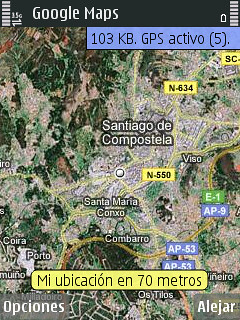
Google ha decidido dejar un poco de lado Java para crear sus aplicaciones móviles y ha sorprendido gratamente con una aplicación nativa para móviles S60 de su Google Maps para móviles, que concretamente soporta de forma nativa el GPS del Nokia N95.

Google Maps

Se nota que la aplicación es nativa, principalmente al arrancarla, es casi instantáneo en mi Nokia N95. Una vez encendida comenzará a bajarse los mapas de Google, ahí, la rapidez, ya dependerá de la conexión de cada uno.

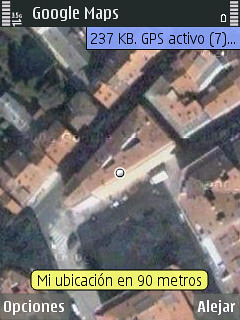
Google Maps

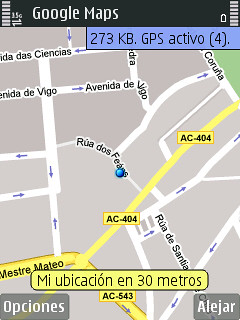
Lo que si me he fijado es que cuando le pides la posición GPS en modo vista satélite te da la posición en la que el cree que estás, mientras cuando se la pidas en el callejero te situa en la calle más cercana a la posición en la que crees que estás. Supongo que esto le puede causar algún despiste en calles que estén muy pegadas. Aunque de todas formas, esto es un fallo típico en cualquier sistema de GPS.

Google Maps

Por último, también indicar, que al igual que la versión anterior, Google Maps para móviles también calcula rutas de un punto a otro, aunque no te guía estilo TomTom

Google Maps

Vía: All About Symbian

{ 4 comentarios }

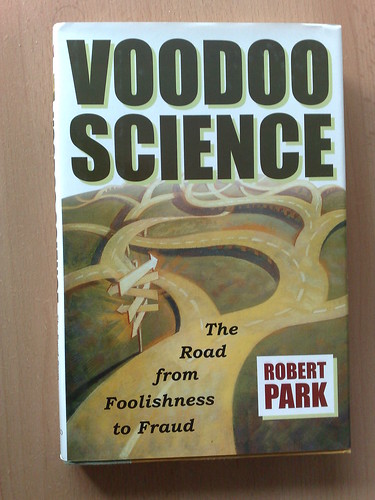
Image of Voodoo Science Voodoo Science. The Road from Foolishness to Fraud por Robert L. Park. Publicado el 15 de Mayo del 2000 por Oxford University Press. ISBN-13: 9780195135152, 230 páginas.

Después de leer la descripción de la contraportada del libro se me antoja la mar de interesante. Ya en How mumbo jumbo conquered the world la introducción a farsantes y estafadores que usan la ciencia como excusa para realizar timos me pareció de lo más entretenido. Este libro, que se centra exclusivamente en eso, no puede tener desperdicio.

Voodoo Science

De la contraportada

Advance praise for Voodoo Science: The Road from Foolishness to Fraud

«Few books have had the impact on my thinking of Charles Mackay’s Extraordinary Popular Delusionsand the Madness of Crowds, published more than 150 years ago. It taught me that massive numbers of individuals have fallen victim to bizarre manias. Professor Park’s Voodoo Science teaches us that even in this age of science, it is still happening. My enthusiasm for this book leads me to recommend it, without reservation, to the intellectual community and The Rest of Us. Long life to Robert Park and his fellow thinkers who, sometimes with little profit to themselves, are so willing and able to lead us out of what I call ‘dumbth.'»

Steve Allen, Humanist, musician and author.

«Bob Park, part urbane physicist, part scrappy Texan, is a national resource. He’s been observing scientist and their wannabes and their hustlers for decades, with the unblinking eye of his trade, and now he tells us what he’s seen, with the narrative cadence of Will Rogers and the blunt-lucid prose of Hemingway. As he crafts his fascinating tales of pride and sham and delusion, he invites us as well to contemplate human nature in its struggle to make sense of, and find a context in, this astonishing universe. I couldn’t put it down.»

Ursula Goodenough, Profesor of Biology, Washington University, and author of The Sacred Depths of Nature

«New discoveries in science and technology have not only fueled an explosive economy but also have provided unheard-of opportunities to those who would mislead the public whether throught their own naivete or downright guile. The sanke oil business is alive and well. Fortunately, we have a superb scientist to strip away the numbo jumbo of these fradulent schemers and reveal them for what they are. It is frightening to read how successful some of these purveyors of nonsense have benn, even in the highest reaches of our goverment. All of us can thank PArk for saving us from ourselves.»

Val L. Fitch, Cyrus Fogg Brackett Professor and Chairman, Department of Physics, Pricenton University, Ex-President of the American Physical Society, Nobel Laureate in physics.

«Science, as Richard Faynmann suggested, is waht we have learned about how not to fool ourselves. There are few-far too few-accomplished scientiest and skilled writers who caree greatly about the ways in which people DO fool tehmselves. Pseudoscience, anti-science, and simple raud are frighteningley popular and dangerous ways, today, of fooling oursevelse about reality. Professor Park is one of those who understand the scams and take the trouble to expose them. Voodoo Science is a powerful but readable assemblage of his findings and ideas.»

Paul Gross, University Professor of Life Sciences, University of Virginia, and co-author of Higher Superstition.

«In Voodoo Science, Robert Park demonstrates how even science itself sometimes gets put in the serrvice of delusion and self-delusion. From Star Wars to cold fusion. EMFs to UFOs, these dispatches from the front lines of scientific foolishness reveal how the things we want to believe often keep us from learning the things we need to know.»

K.C. Cole, author of the best-seller The Universe and the Teacup: The Mathematics of Truth and beauty.

«Television producers and newspaper editors have convinced themselves of a cowardly myth: the paranormalism may be drivel, but you have to serve it up because ‘people’ enjoy it more than its debunking. Professor Park does more than debunk, he crucifies. And the result is huge fun. I finished this brilliant book within a day, and then fel such withdrawal syptoms I went right back to the beginning and started again. Not only will you enjoy reading it. You’ll never again waste time or your money on sttrologers, ‘quantom healers,’ homeopaths, spoonbenders, perpetual motion merchants, or alien abduction fantasists.»

Ricahrd Dawkins, Charles Simonyi Professor for the Understanding of Science, Oxford University, and author of Unweaving the Rainbow

{ 2 comentarios }

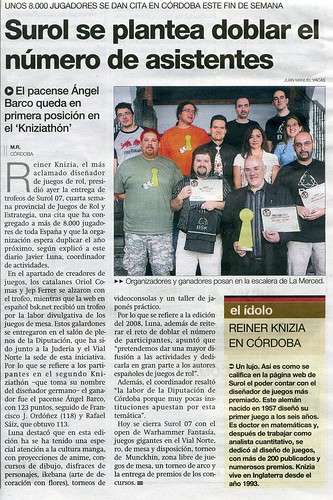
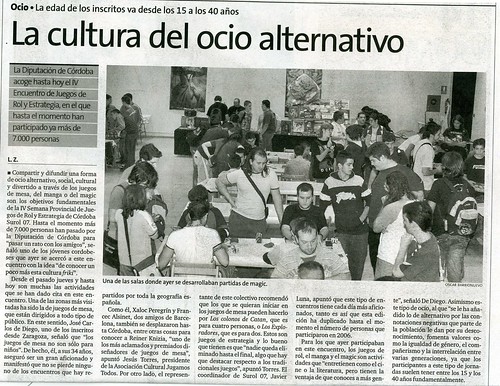
Ayer regresé de Córdoba, después de pasarme 4 días jugando sin parar, tengo que escribir una crónica de mi viaje pero por el momento aún estoy atendiendo a todo lo que se me acumuló de trabajo en estos cuatro días de ausencia, mientras tanto os dejo este par de artículos que salieron en periódicos de la región donde se celebraba el Festival de Juegos de Mesa Córdoba 2007.

De entrada el Diario de Córdoba confunde los juegos de mesa con los de Rol y cambia de profesión al pobre de Knizia

Festival de Juegos de Mesa - cordoba

El periódico El Día también menciona el evento.

Festival de juegos de mesa - el dia

A ver si hoy por la tarde tengo un poco más de tiempo y os comento lo bien que me lo pasé 😉

{ 2 comentarios }

Cita

por davidgp el 15/10/2007

Instrucciones para dibujar una rana:
1-Esperar a que deje de saltar

JRMora.com

{ 0 comentarios }

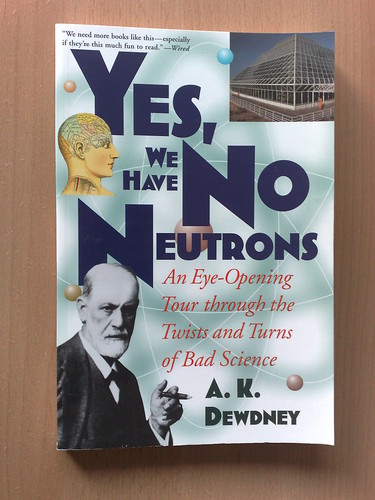
Yes, We Have No Neutrons. An Eye-Opening Tour through the Twists and Turns of Bad Science por A. K. Dewdney, Publicado el 11 de Agosto de 1998 por Wiley, ISBN-13: 9780471295860, 192 páginas.

Otro ensayo más que me han prestado este año, en esta ocasión toca ver equivocaciones científicas que dan lugar a explicaciones totalmente equivocadas en el mundo de la ciencia actual. Promete ser divertido.

Yes, We have No Neutrons

De la contraportada

«Dewdney manages to make this catalog of error entertaining as well as instructive; good medicine for both skeptics and true believers.»

Kirkus Reviews

Yes, We have No Neutrons

In the acclaimed 200% of Nothing, A. K. Dewdney humorously uncovered the alarming shenanigans of those who use «bad math» to deceive us. Now Dewdney focuses his sharp-witted perspective on the most hallowed of human endeavors: scientific inquiry. Yes, We Have No Neutrons is an absorbing and deliciously irreverent exposé of science gone wrong, featuring eight notorious cases that range from the wacky and ridicolous to the downright disturbing.

«Written with wit and a touch of pathos-and sure to please science lovers.»

-Publishers Weekly

«A useful and easily read introduction to bad science.»

Scientific American

A.K. Dewdney is the author of 200% of Nothing, also published by Wiley, and the former «Mathematical Recreations» columnist for Scientific American

{ 0 comentarios }

Para matar el tiempo un domingo aburrido

por davidgp el 14/10/2007

Bueno, esta semana yo estoy matando el tiempo en Córdoba, ya desde hace unos cuantos días, así que realmente no he tenido mucho tiempo de mirar nada por Internet que poner aquí. Así que aquí os quedáis con dos de mis clásicos durante los domingos, XKCD y La Decadencia del Ingenio

Exploits of a Mon

Tratamiento:

B: Te recuerdo que todo lo que me digas quedará entre nosotros. Ningún médico puede ir aireando los secretos de sus pacientes bajo ningún concepto.

Y por último, Effect and Effect

{ 1 comentario }

Finalistas al Premio al Juego del Año

por davidgp el 13/10/2007

Esta mañana se han anunciado los finalistas al Juego del Año, que curiosamente los he probado todos. Aquí tenéis la lista, con enlaces a comentarios de los juegos en este blog (lista por orden alfabético).

{ 0 comentarios }

#44 The Journey of Man por Spencer Wells

por davidgp el 12/10/2007

Image of The Journey of Man The Journey of Man es un libro que me enganchó desde el principio. Wells comienza muy bien la historia narrándonos como se empezó a especular del origen evolutivo del hombre. Desde las hipótesis de Darwin, pasando por quienes querían creer que las diferentes razas eran diferentes especies y por ello se podías justificar cosas como la trata de blancas…

Poco a poco nos va llevando a lo que conocemos que es cierto hoy en día. Gracias claro a los estudios genéticos que se han realizados. Especialmente nos cuenta como a través del cambio en el adn mitocondrial en las mujeres y el adn en el cromosoma Y de los hombres se puede deducir que la especie humana se originó en Africa.

Una vez determinado nuestro punto de origen, Wells nos lleva desde Africa a todos los continentes, explicándonos como nos movimos de un sitio a otro, comprobando que esto que demuestra la genética también se corresponde a la evolución del lenguaje.

De la contraportada

«Spencer Wells, whose genetic work has contributed to our understanding of human prehistory, has provided an acount of the spread and mixing of the human species from its origin in Africa that is both scientifically accurate and accessible to the nonscientist.» – Richard Lewontin (Hardvrd University, author of It Ain’t Necessarily So: The Dream of the Human Genome and Other Illusions)

Leading genetcist and explorer Spence Wells uses cutting-edge science to rewrite the fascinating story of our earliest ancestors – a companion to the PBS/National Geographic Special.

Around 60,000 years ago, a man-genetically indentical to us-lived in Africa. Every person alive today is descended from him. How did this real-life Adam wind up as the father of us all? What happaened to the descendants of other men who lived at the same time? And why, if moderm humans share a single prehistoric ancestor, do we come in so many sizes, shapes, and races?

Examining the hidden secrets of human evolution in our genetic code, Spencer Wells reveals how developments in the revolutionary science of population genetics have made it possible to create a family tree for the whole of humanity. Replete with marvelous anecdotes and remarkable information, from the truth about the real Adam and Eve to the way differing racial types emerged, The Journey of Man is an enthralling, epic tour thorugh the history and development of early humankind.

«Written with much verve, easy to read, and up-to-date on many important developments.» –Luigi Luca Cavalli-Sforza (Standford Universit, author of The History and Geography of Human Genes and Genes, Peoples, and Languages.

{ 0 comentarios }